
Social Structure
In focusing on individual achievement, are we losing the glue that held the Black community together?

In the last few weeks, the publishers of Ebony and the Root both issued their annual surveys of achievement, The Ebony Power 100 list and The Root 100, respectively. Both lists, and their accompanying galas, have become huge audiences draws and have sparked health debate and conversation about what leadership looks like in the 21st century. The lists feature many whom you would expect, but also a wide array of new voices across a diverse range of industries and pursuits who touch the culture in ways that are powerful, and forward-thinking.
I especially find it admirable that both lists take pains to lift up people who don’t often get their due. They are redefining leadership in a new and fresh way.
That was not always the case.
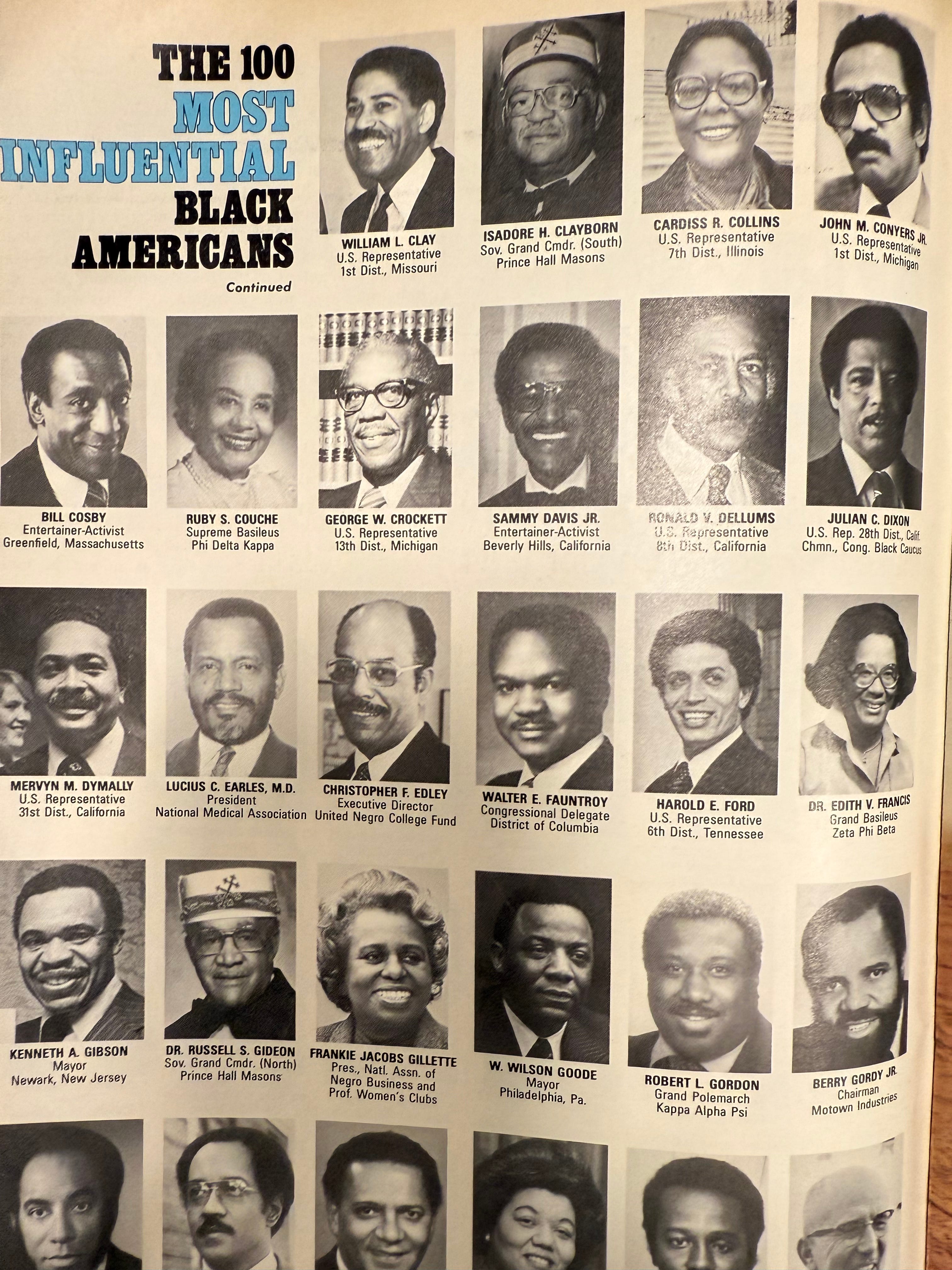
While The Root 100 is much more recent, the Ebony Power 100 is an outgrowth and rethinking of a decades long feature, The 100 Most Influential Black Americans.
I recently found a May 1984 edition of Ebony in box of Michel Jackson memorabilia my wife had been saving. In that edition is also that year’s 100 Most Influential list. The contrast could not be more striking. A full 25% of the list is occupied by the sitting Congressional Black Caucus members. Appropriately, the Rev. Jesse Jackson, who had just finished a historic run for president, was on it. There are a few well-known entrepreneurs (John H. Johnson, Earl Graves, George Johnson, John Sengstacke) and a handful of corporate executives. But the bulk of the list is made up of people who ascended to prominence and official roles in the post-civil rights 70’s —mayors of big cities, military leaders, heads of major Black church denominations, state legislators and federal judges (Thurgood Marshall was still on the Supreme Court) and the heads of historic black organizations, leaders of the Divine Nine and the major professional groups, and deeper into the fabric, the Sovereign Grand Commander of the Northern Prince Hall Masons, the Imperial Potentate of the Mystic Shrine, the Grand Exalted Ruler of the Elks and the president of the National Association of Colored Women’s Clubs.
Notably there are no athletes present, though Magic Johnson was dominating basketball and Muhammad Ali was still very much around. There is just a smattering of entertainers (Michael Jackson, Sammy Davis Jr. Berry Gordy and Bill Cosby), who were at that time a few of the most influential people in the world regardless of race.
But the 1984 list fairly accurately reflects the approach of the era to recognizing leadership and advancement, determining who influences whom, who impacts what and why. It was grounded in the traditional ways of entering the middle class, the pre-approved symbols of status - education, titles, mainstream acceptance, social status. cash.
This all changed more recently than you might imagine.
I happened to be in the editorial meeting at Ebony when it flipped. I talked recently with Harriette Cole, who edited the magazine side at the same I led the digital version, about that meeting and we both remember it being relatively contentious.
It all started with a basic but profound questions from some staff about the list for 2008:
“Should we continue to include people on the list by default or tradition? Is one’s title, or the size of the organization they lead markers of actual influence or just impressive credentials? Should, for example, a congressman who voted against the interests of the community, be on the same list as a ride or die soldier, just because he or she was also member of the House? “
After some arguments, some pushback and much careful thought, everyone came to the same conclusion about the need for change. That decision turned into The Ebony Power 150, a sort of transitional extended list that tried to elegantly thread the need between a shift and tradition.
The Ebony list is now back to just 100 and looks very different now, as it should.
Ultimately, these lists are not particularly important. They attract readers and conversation and are probably more reflective of the biases of the editors as opposed to an empirical survey of impact. Still, they are indicative of how we have begun to process who and what is “relevant” to the present and future of the Black community.
And if I’m honest, I am (and I think we all should be) at least slightly concerned that so many venerable organizations that once help up the Black community are no longer a part of our discussion. I am not necessarily arguing that should be, but it a question worth examining.
The Masons, the Elks and Shriners still exist. Jack and Jill of America and The Links are bigger and more publicly visible than ever, and more visible. The Divine Nine still attract college students. There are more CBC members than anyone who doesn't work on Capitol Hill would ever recognize. Yet they rarely make the lists in the last decade.
That said, I know few people who can articulately outline what the National Urban League does. As recently as last week, a popular comedian, Gary Owen, posted a joke on Instagram about “not knowing anyone who went to college on a UNCF scholarship” - funny, but a complete misunderstanding of how the UNCF works. And then there are once-powerful organizations such as TransAfrica Forum and African that used to lead the global discussion on Pan-Africanism that I had to research to find out if they still are in business (TransAfrica is, Africare is not).
But is our sense of their contemporary relevance based on their social media prowess and their storytelling ability? Have they truly lost ground in the community because we are thinking and proceeding differently in regard the culture? Did a whole generation of charismatic leaders simply fade away, taking the attention along with them?
Or have we lost faith in the principle of organizing altogether, and are we gaining or losing anything because of that?
Black Lives Matter, as one example, was successful in large part because of its de-centralized nature, smartly eschewing charismatic leadership in trade for a non-traditional structure that was less vulnerable to meddling and infiltration. But when it was attacked, there also was not a structure to keep it protected.
I don’t have the answers, just questions that we should consider as we progress.
I suppose whether we have lost anything depends of whether you think these traditional organizations were the glue that held the community together and passed on traditions in troubled times, or gatekeepers of a hierarchy and a social order that were barriers to new ideas and new leadership. Both things can be true.
What I hope —what we should all hope —is that in our celebration of the independent and individualistic spirit we have not tossed out a sense of the power and importance of organizations, and by extension the need to organize, especially in a time when so much of what those organizations fought for is being eliminated inch by inch, policy by policy.
Perhaps what’s really happening is that we have — in the way that Black people always do— simply found new and innovative ways to build those structures.